
 +1 302-298-0035

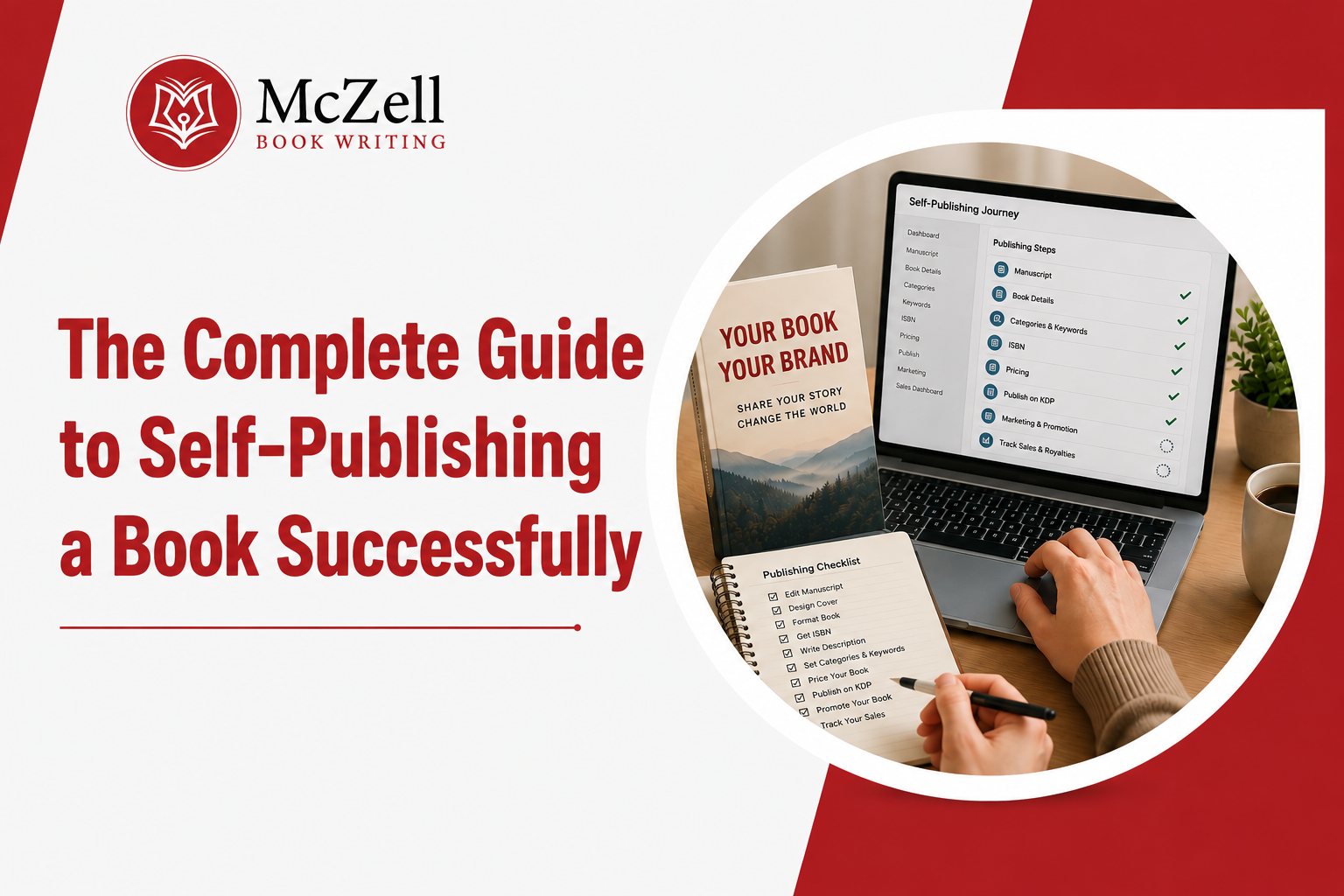
Self-publishing has become more of a first choice than a last resort and one of the most admired and lucrative ways to become a published writer. Previously regarded as a way to compromise authors who either did not get a conventional book deal, it is a strategic decision that is now being made by bestselling authors, entrepreneurs, and experts in their fields. But successful self-publishing isn’t as simple as uploading a Word document to Amazon and hoping for the best. It involves meticulous planning, skilled implementation and, in most instances, the assistance of seasoned book publishing services to wade through technical and strategic complexities that turn a refined issue into an amateur one.
This step-by-step manual takes you through all that you will need to know to publish your book successfully, including the preparation of your manuscript, marketing it, and so on, so that you do not have to rely on guesses when you do self-publishing.
Why Self-Publishing Has Become a Serious Career Path
Ten years ago, self publishing was taboo. Nowadays, it is all a different story. Authors who choose self publishing services have complete creative control, a much larger share of the royalties, and can have their books in the market within weeks instead of the 12-18 months that it takes in the traditional publishing cycle.
This change has been propelled by the likes of Amazon Kindle Direct Publishing (KDP), which has democratized distribution and has opened up Amazon book publishing to just about anyone. On top of that, there has been the emergence of professional book publishing services providers, who are engaged to do the editing, design, and formatting, and today, authors who are self-published can create books that are as good as the traditionally published books.
With that said, quality cannot be an accident. It is a product of the systematic procedure, of which many novice writers are unaware.
Step 1: Finish and Polish Your Manuscript
First of all, your manuscript should be finished and revised. This involves going through several editing processes:
Developmental editing focuses on the general structure, pacing, character growth and the story or argument flow. Here is where big problems can be caught and resolved before you invest time polishing prose that could be trimmed all the way.
Line editing concentrates on the clarity, tone, and consistency of voice in the entire manuscript, on a sentence level.
Copyediting identifies mistakes in grammar, punctuation, consistency, such as character name inconsistency, chronology or formatting in nonfiction citation.
Proofreading is the last step prior to publication, which picks up any remaining typos or formatting errors.
One of the most widespread errors that self-published authors make is skipping at least one of these stages. Critical reviews will be left early, and a book that was well written can be ruined by a single carelessly edited chapter.
Step 2: Understand Your Formatting Requirements
One of the most technical and least considered aspects of self-publishing is book formatting. What appears to be a nice piece of writing in a Word file may not translate to a real book, be it a print paperback, hardcover, or e-book.
The correct formatting of books entails:
- Uniform heading of the chapters and title pages.
- Right margins, gutters, and bleed in print editions.
- Navigation of e-books that works with the table of contents.
- Use a proper font and size to read.
- Running head and page numbers.
- Front matter (copyright page, dedication, table of contents) and back matter (author bio, acknowledgments, additional resources).
E-books and print books need completely different ways of formatting. An e-book must reflow correctly across various screen sizes and devices, whereas a print book must have fixed layouts that are calculated to the exact trim size you are publishing in. Some of the reasons why many authors outsource professional book publishing services are that formatting mistakes, such as incorrect reflows of text on a Kindle or margins that are sliced off during printing, can render a book to appear unprofessional despite having a great piece of writing.
Step 3: Register Your ISBN
The topic of ISBN registration is something that is not clearly understood by first time self-publishing authors, but is required to help keep track of sales, register your book in bookstores and libraries, and help establish it as a valid sellable product.
An ISBN number (International Standard Book Number) is a 13-digit number that is assigned to a particular edition and format of your book. This implies that your e-book, paperback and hardcover books will all need their own unique ISBN.
A few important points about ISBN registration:
- In the United States, Bowker (myidentifiers.com) assigns ISBNs, and when you buy your own ISBN (instead of a free one offered by a service such as KDP), your book will be registered under your name or imprint as the publisher, not that of the service.
- Amazon KDP provides free ISBNs for e-books and print editions, but taking advantage of free ISBNs provided by Amazon implies that Amazon is the publisher of record, and your ability to sell elsewhere is impacted.
- You can be more flexible and have more control when buying your own ISBN when you plan to sell your book through several different platforms (Amazon, Barnes and Noble, IngramSpark, independent bookstores, etc.).
- In fact, some countries have made the issuance of ISBNs free of charge via government agencies, and as such, you would want to ensure that you check out your national ISBN agency first before buying one.
This step is important to get right early on, since it will help to avoid complications in the future, in case you intend to distribute to more than just one platform.
Step 4: Choose Your Publishing Platforms
The most popular place to begin self-publishing is Amazon book publishing using KDP, and with reason. It provides the biggest online book marketplace in the world, simple royalty models and both e-books and print-on-demand paperback tools.
But going only to Amazon restricts your access. Additional key platforms and services to consider include:
- IngramSpark provides broader distribution to bookstores, libraries and foreign retailers.
- Barnes & Noble Press: This can be used to access readers who use non-Amazon services.
- Apple Books and Kobo, which make your e-book visible in other reader ecosystems.
- Draft2Digital, which makes it easier to distribute to a variety of e-book sellers with a single upload.
A common practice by many authors is the hybrid model: KDP to accomplish the majority of their sales and visibility, and then IngramSpark or Draft2Digital to have a wider distribution. A professional book publishing service can assist you in finding out the optimal platform mix according to your genre, intended audience and future objectives.
Step 5: Design a Professional Cover
It is a fact that people do judge a book by its cover, and in a self publishing marketplace full of new books, a professional genre-appropriate cover cannot be compromised. The design of the cover must be in keeping with modern trends in your genre, as readers sublimely associate some forms of visual representation with some kinds of books. A thriller-like look of a memoir cover, or a romance novel-like look of a business book cover, sends the wrong signal before a reader reads any description.
Design of covers is typically part of most self publishing services, and involves professional illustrators or designers, who are familiar with genre conventions and expectations in the market.
Step 6: Write a Compelling Book Description and Metadata
The product page of your book is working heavily to persuade a reader who is browsing to purchase your book, and metadata is even larger than most authors would think.
This includes:
- An attractive, advantageous book description.
- Proper category and genre selection, as the choice of the appropriate categories is a factor in how visible your book becomes.
- Relevant keywords that correspond to how the readings search for books similar to yours.
- A biography of the author that makes him or her credible and trustworthy.
A frequently neglected element of successful self publishing services is getting metadata correct, because even a well written book might not do well when it is put in the wrong category, or not seen in search results.
Step 7: Plan Your Launch and Marketing Strategy
Publishing the book is not the finish line, it’s the starting point for marketing. An effective launch usually comprises:
- The first one is to establish an email list or author platform before the launch day.
- Getting early reviews in the form of advance reader copies (ARCs).
- Conducting a co-ordinated launch week to create initial sales momentum and Amazon ranking.
- Use social media, podcasts or guest blogging to increase reach.
- Thinking about paid advertising using Amazon Ads or social networks after the book has been posted.
Most of the authors undermine the efforts that they need to market their book once they have publish your book, believing that a good manuscript will sell itself. The fact is that discoverability is among the largest issues of self-publishing, and an aggressive marketing strategy is what frequently results in a book that quickly fades into obscurity and those that develop long-term sales.
Common Mistakes to Avoid When Self-Publishing
Hurrying the editing process. Attempts to save time or money by not doing developmental editing or proofreading nearly always backfire as negative reviews.
Using a free, low-quality cover design. An amateurish cover is a sign of low quality, even before the reader picks up the book.
Ignoring formatting standards. One of the quickest methods of losing the trust of readers is poor book formatting, and the broken formatting can be easily seen in e-book formats.
Skipping ISBN research. The free platform ISBNs may restrict the distribution opportunities in the future because there is no knowledge of the tradeoffs.
Underestimating marketing. The most prevalent causes of poor performance of self-published books are the assumption that Amazon book publishing will create visibility without any promotion.
Attempting to do it all on your own. Although self-publishing is independent, most of the successful authors still use a mix of professional editors, designers and book publishing services to fill the gaps in their own expertise.
Why Professional Support Makes a Difference
Although it is certainly possible to do self-publishing alone, the authors who achieve the greatest success tend to make it an endeavor like the one that professional publishing is. This frequently involves contracting external skills at crucial points: a developmental editor to help the manuscript shine, a formatter to make the book present itself professionally in all formats, and a designer to make a cover that will stand out in a cluttered market.
There are comprehensive book publishing services that directly address these gaps, providing all the way up to editing and book formatting, as well as registering an ISBN and setting up distribution, and authors can concentrate on writing instead of working through the technical/administrative labyrinth of publishing.
Final Thoughts
It requires much more than completing a manuscript to successfully self-publish a book. It involves editing, formatting, registration of an ISBN, choice of a platform, cover design, and marketing, which are all important to the perception of your book and its success in the market. No matter whether you decide to do it all yourself or turn to the services of a professional self publishing services to do the work, knowing what it takes to launch your book the right way the first time places you in a much better position to succeed in publishing your book.
Through proper planning and assistance, self-publishing is not only an option to conventional publishing, but it also remains a legitimate, strategic course towards the establishment of a solid body of work.